Categories
PR Blunders Social Media Twitter

Twitter’s Downfall Began Long Before Musk’s Mistakes

Unless you’ve been living under a rock, you likely know that Twitter is in a freefall and has been since Elon Musk purchased the platform for a highly inflated price of $44 billion.

You’ve likely also seen his series of blunders, including firing the executive team without having done any due diligence on their value to the company or their individual payout packages – which resulted in Musk begging some of them to come back.

Later, in a desperate attempt to make his purchase profitable, Musk unceremoniously fired fifty percent of the staff. Of course, just days later, he realized the company needs a workforce to keep it running, so, he once again begged some staff to return.

Next, as advertisers fled the platform, he tried to drive revenue through the ill-fated $8 Blue Verification Checkmark. This, naturally, resulted in chaos as Twitter users earned their “verification” for fake accounts to impersonate real brands.

Then, he released his famous ultimatum, giving everyone who remained 24 hours to decide if they want to go “extremely hardcore” and work long hours or to resign and take a severance. This move couldn’t be more tone deaf in the era of people “.working their wage.”

Unsurprisingly, 75% of the company opted for the severance packages, leaving Musk to wonder if anyone will remain to actually run the company. And, departing staff have been hilariously roasting Musk since, to the point of Musk shuttering the offices.

A few things strike me in this entire scenario. First, let’s talk about Twitter’s value in general.

The Value of Twitter for Brands

Truth be told, although I once advocated for the platform back in 2004, by 2009, I was reporting that 40% of Tweets were drivel.

And, by 2015, my use of the platform dropped significantly as I simply wasn’t seeing much click-through (Twitter drives only 7% of all website click-through, compared to Facebook, which still to this day, drives 55% of click-through.)

Although I still shared the occasional tweet or link to an article, I just didn’t see the value in those Tweets that was once there.

The Twitter Experience for Women

Worse still, was the overall Twitter experience.

I had a conversation in 2019 with another agency leader – a male – who was still a big fan of the platform. He couldn’t understand why I was no longer a fan of Twitter.

It was in this discussion when I realized that men and women have very different experiences on Twitter. I explained that, for me, Twitter had become a cesspool of misogyny, hate and d**k pics.

No longer was it a forum for link sharing and conversation, at least not for women – or, more specifically for me. I couldn’t go on Twitter anymore without being accosted by incels and political extremists either in replies or in my DMs.

Twitter’s Past Glory

There is no doubt that Twitter was once an incredibly value resource for many.

In 2009, I shared how Twitter was redefining customer service and helping brands quickly resolve issues and create customer engagement.

In 2013, I reported on how Twitter was driving sales for SMBs.

And, even as recently as 2020, Twitter helped brands communicate COVID-19 restrictions.

But, the fact is, Twitter was a mess of bots and bullies long before Musk entered the scene. And, from what I am seeing, it’s only getting worse.

What do you think? Will Twitter survive this current state of chaos? Or, has the platform run its course?

Categories
Brand Management

Why Logo Design Matters: A Georgia Elementary School is Under Fire

Logo design is a unique art.

There are some logos that are pure genius – especially the ones in which brand messages are hidden, such as the Spartan hidden in the Spartan Golf Club design, or the Bronx skyline within the Bronx Zoo logo, and of course, the arrow within the FedEx logo.

Then, there are logo designs that are so egregious, I simply cannot fathom how they passed what had to be at least a few layers of approval.

Embarrassingly, one such design has emerged from an elementary school in my hometown of East Cobb County, Marietta, Georgia and is (rightly) causing a PR headache for the district.

It seems East Side Elementary School either has administrative staff who are utterly oblivious to history – which is not a good sign for educators – or their staff deliberately embraced Nazi imagery considering their new logo is a near exact replica of the Nazi War Eagle. Even the “ES” for East Side looks like a swastika in the context of the Nazi eagle.

There are so many things wrong with this logo – the first, of course, that it is a Nazi symbol used at a time when neo-Nazis march freely through the streets in this country shouting their hate.

Of course, the school says this similarity is accidental. A district spokeswoman issued the following statement:

“Yesterday, we learned of concerns about a new logo at East Side Elementary. The roll-out of this logo has been halted, and we are immediately reviewing needed changes. We understand and strongly agree that similarities to Nazi symbolism are unacceptable. Although this design was based on the U.S. Army colonel’s eagle wings, stakeholder input has been and continues to be important to our schools. We appreciate those who took time to share their thoughts and will make sure all input is reviewed as changes are considered.”

This leads me to the second thing that’s wrong with this logo: ignorance of the past.

Now, if the school wants to put the blame on a junior designer, something they claimed in earlier statements, that just proves the need for continued education and to stop the current whitewashing of history.

This is the take of Dov Wilker, the regional director for the American Jewish Committee, who doesn’t think the antisemitic imagery was intentional.

“What it demonstrates to me is a lack of overall education about global issues and historical facts. The ignorance that we see when symbols like this are adopted is really scary and something that we should be very concerned about for our community and for the future. My question for the school district really is: ‘How are they going to use this as a learning opportunity for the schools — and the students and the teachers and the employees of the district —  as they come back to school?'”

I’d also add that even if a junior designer who was ignorant of the logo’s meaning created it, does that mean the principal and school administrators were equally ignorant of the symbol? If so, then Wilker is absolutely right that education is needed for the teachers as well as the students.

Beyond that, I’d add that the logo design itself – even without the Nazi similarity – does not fit the audience, which is the number one mistake in logo design. The district claims the logo was based on a “U.S. Army colonel’s eagle wings.”

But, this is an elementary school. It’s not a military school. These are little children. Generally mascot designs for elementary schools are more cartoonish. They are usually fun and colorful.

This design is harsh and cold and – as the district said – militaristic. None of these adjectives fit with an elementary school.

So, what’s the lesson here?

1. Always design for your audience. If your audience is children, keep the logo light, bright, colorful and fun. If you’re designing for a corporate brand, make it eye-catching and professional, but always consider the message you want to convey. Whatever your brand, you want to ensure your logo is appropriate for your business.

2. Think about the meaning of the colors you use. If you want to evoke trust, use blues; for energy, try red. In fact, consider the psychology of color design when selecting your design.

3. Keep it simple. Your logo needs to be memorable and easily understood at a glance. Good logos deliver something unexpected and are unique without being complicated.

4. Avoid trends. An effective logo should be timeless and should avoid trends. It should last the test of time. How will your logo look in 10 years time?

5. Keep it versatile for resizing. A good logo can be used in a variety of sizes and should still convey your brand’s image in back and white.

6. Always consider the implications of your designs – think about what your design evokes, something the East Side Elementary School certainly should have done.

Categories
Marketing Marketing Strategy PR Blunders Public Relations

Currahee Brewing Company Uses White Nationalist Lingo and Imagery, Reminding Everyone Why You Should Check the Meaning of Co-opted Terms


screen-shot-2020-06-01-at-12.14.33-pm-1As protests erupt from coast to coast in response to continued police brutality against people of color in the United States, the Currahee Brewing Company, made its own headlines by releasing a new beer using language and imagery of alt-right white supremacy group the Boogaloo Bois. If you aren’t familiar with them, this is a group in the U.S. of white men who want a violent civil war in this country. (In fact, this is the group that traveled to “blue states” to protest stay-at-home orders and are allegedly infiltrating this weekend’s peaceful protests to create the violence they so crave.)

Now, the co-owner of the Georgia-based beer company issued a statement insisting he didn’t know what “Boogaloo” meant when they named their beer after it and dressed George Washington in the Boogaloo’s preferred attire of Hawaiian shirts on the bottle.

“It’s unfortunate. I can understand why some people are upset about it. I’m disappointed with myself not knowing, [not] taking more steps when we named the beer to figure out kind of more of the meaning, not just going off a couple of things you see on the internet … We are very Constitutionally-oriented. Out First and Second Amendments, all amendments, we try to support and defend … We were seeing some memes on the internet, quite a few about George Washington and kind of the joke was him wearing a Hawaiian shirt, you know a modern day General obviously is not going to be wearing a Hawaiian shirt. So we kind of played with that and we kind of rolled with it … We did not by any means know that is was being used by any type of racist white nationalist group at all, or we would never have used it or we should have dropped it.”

Brandon Hintz, co-owner of Currahee Brewing Company

The beer can itself, produced by Currahee, bears an adaptation of a famous portrait of George Washington painted by American artist Charles Wilson Peale while Washington was still alive. One thing that makes Hintz’s claim of ignorance a bit hard to believe is that included on the beer can’s image under George Washington’s right elbow is a small black man in a hat, crouched down on all fours as though picking crops. This is not something that was a part of Peale’s original painting. So, someone had to add that to the already racist imagery.

That said, I will take Mr. Hintz at his word that he didn’t intentionally adopt the name and imagery of a group that advocates death to people of color, liberals, minorities and immigrants in this country.

What Mr. Hintz and his marketing team did wrong, however, was to adopt this imagery and language without taking the two seconds required to Google what the name Boogaloo and their Hawaiian shirts mean. In fact, I’d be interested to see what memes inspired him  to adopt the images of a known hate group because their memes, which I will not post here, clearly state their desire for a “violent revolution.”

Nonetheless, let’s assume the Currahee Brewing Company really didn’t know the meaning of the memes that inspired the production of new designs on their beer cans. Can we all please remember before you adopt any imagery, trending hashtag or meme message, it’s a good idea to take two seconds to research the meaning behind the message you will forever tie to your brand.

Categories
Media Relations PR PR Blunders Public Relations

ABC Reporter Forgot His Pants for GMA Interview – New Media Training Reminder: Be Fully Dressed!

Just a few days ago, I took a new client through media training. We covered everything from how to use “bridges” to stay on message; how speaking in lists lets you own the time; how to ensure you look good and sound good on the inevitable video interviews that are happening now as everyone shelters in place.

Well, there is one thing I didn’t include in my media training, which I believe I will now add: wear pants!

It seems Will Reeve, an ABC reporter, who did a piece for Good Morning America on Tuesday about pharmacies using drones to deliver prescriptions to people in a Florida retirement village.

At the start of his chat with host Amy Robach, Reeve’s camera had a pretty good shot and the graphics at the bottom of the screen covered up a lot.

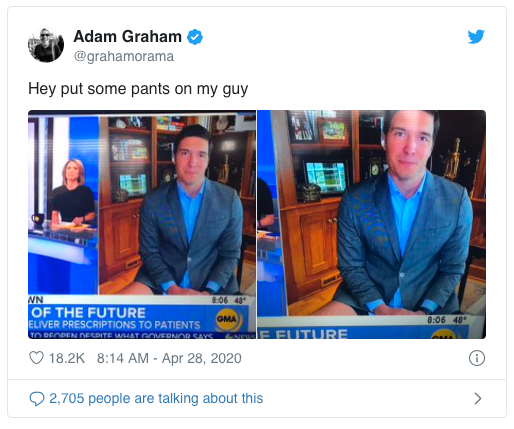
But as his segment was wrapping up, it was just a wide shot of Reeve onscreen — with a smaller graphics banner — suddenly it became apparent that he was wearing only the top half of his suit.

GMA reporter

Of course, viewers began to call out his mistake in social media.


Screen Shot 2020-04-28 at 12.17.40 PMScreen Shot 2020-04-28 at 12.17.47 PMScreen Shot 2020-04-28 at 12.17.55 PMScreen Shot 2020-04-28 at 12.18.04 PM

This prompted Reeve to post a reply in which he hoped everyone got a much needed laugh as a result.

Screen Shot 2020-04-28 at 12.18.22 PM

While this is hilarious and definitely understandable in this time of quarantine, I now feel compelled to remind everyone – when you’re on camera with reporters whether you are using Skype, Zoom, Cisco WebX or FaceTime, put on some pants!

Thanks for the laugh, Will.

Categories
Advertising Crisis Communications Crisis Response Marketing Strategy PR Blunders Public Relations

Backlash from Peloton Ad Causes Company Shares to Drop by 9% or $924 Million

We’ve all seen the jokes over the years of hapless husbands gifting their wives vacuum cleaners and irons for the holidays and the fights that ensue due to the perception that the wife’s only role is that of housekeeper. We’ve even seen that joke expanded to include husbands who gift their wives exercise equipment with the underlying implication that she needs to lose weight.

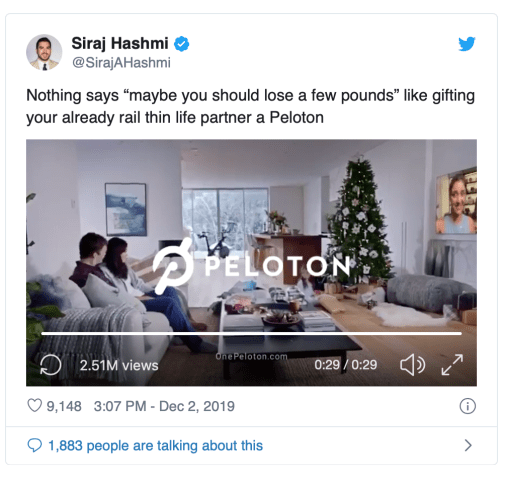
Well, it seems the stationary bike manufacturer, Peloton missed this long history of gifts you shouldn’t give when they created and released an ad featuring a rail-thin woman receiving a Peloton stationary bike for Christmas. The ad proceeds to show how the woman gets up in the early morning hours, next to her sleeping husband, to work out on her Peloton and how grateful she is a year later after posting daily evidence of her workouts every day, lest her husband think she is slacking off.

Online outrage over the ad drove down the company’s shares by 9% on Tuesday, wiping out $942 million in value and prompted calls for the stationary-bike maker to pull the commercial.

Critics on social media said the ad was sexist and made it seem like the woman was being pressured to keep her weight in check.

Screen Shot 2019-12-04 at 11.53.02 AMScreen Shot 2019-12-04 at 11.53.27 AMScreen Shot 2019-12-04 at 11.53.37 AM

In fact, a parody video mocking the Peloton ad has seen one million more views and shares that the original ad.

Some folks like to say “any publicity is good publicity” but I believe anyone who owns Peloton stock may find that saying to be as ridiculous as PR pros do.

Bottom line – in this era of offense – the worst thing a brand can do is to be tone deaf about the message they are putting out there.